California Solar Financing · 2026 Comparison
California Solar 2026:
Purchase vs Loan vs Lease vs PPA
— And Why Prepaid Leases Are Winning
By Ed Watts · Solar With Watts · Updated March 2026 · 10 min read
The federal solar tax credit is gone for individual homeowners. SGIP battery rebates are waitlisted. And NEM 3.0 changed the export math for PG&E and SCE customers. In 2026, the way you finance your solar system matters more than ever. Here's the honest breakdown of every option — and why one structure is pulling ahead for most California homeowners right now.
📋 2026 context: The federal Residential Clean Energy Credit (ITC/25D) is no longer available for individual homeowners on systems placed in service after December 31, 2025. Only third-party system owners can claim the 30% credit through 2027. This changes the math significantly — and it's the main reason prepaid lease financing is outperforming direct purchase for most homeowners this year.
Free · No Credit Pull · 60 Seconds
Not Sure Which Option Is Right for You?
We'll run all four options side by side with real numbers for your home, utility, and bill. No obligation.
See If My Home Qualifies →
🔒 No spam · No credit pull · Free · 1-hour local follow-up
The Four Ways California Homeowners Go Solar in 2026
Every solar financing conversation starts with the same four options. What's changed in 2026 is how they stack up against each other — because the ITC is gone and export rates are lower. Here's each option assessed on its own terms.
You buy the system outright. No loan, no monthly payment, no third-party involvement. You own every panel and every kilowatt-hour from day one. In a normal year this would be the gold standard — but 2026 changed the math.
Without the 30% ITC, you're paying full sticker price. A $60,000 system costs $60,000. That's $18,000 more than the same system via prepaid lease this year. The long-term ROI is still strong — you'll eliminate your utility bill over 20–25 years — but the payback period is significantly longer without the tax credit cushion.
✓ Best for: homeowners with significant cash reserves who want maximum long-term ROI and don't mind the higher upfront hit without 25D.
Finance the system with a solar loan — $0 down, monthly payments, own the system from day one. You build home equity and eliminate your utility bill over time. The problem in 2026: dealer fees and interest rates quietly eat into your savings more than they did when the 30% ITC offset them.
Standard solar loans (secured, mortgage-style) keep your monthly payment fixed even after lump sum payments. Unsecured re-amortizing loans — like the ones we offer — are structured differently: when a significant payment hits principal, the loan re-spreads and your payment drops immediately. For SMUD customers especially, this structure makes sense because the battery rebate check can trigger an instant payment reduction.
✓ Best for: homeowners who want ownership from day one, have good credit (650+), and plan to stay long-term. Watch dealer fees and interest rate — they determine whether this is a slam dunk or marginal.
This is the financing structure that changed the most in 2026. A third-party company owns the system, claims the 30% ITC at the corporate level, and passes the full 30% discount to you as a price reduction at the point of sale. You pay the discounted amount — cash or financed — and own the system outright after 5 years.
On a $60,000 system, that's $18,000 off before your loan is ever originated. No tax filing, no minimum tax liability, no waiting for a refund. The discount is applied before you sign. For SMUD territory homeowners, this stacks directly with the battery rebate and VPP programs — three separate incentive layers running simultaneously.
⭐ 2026 sweet spot: strongest net cost + best savings combination for most California homeowners this year. The 30% discount replaces the ITC without requiring tax liability. Stacks with SMUD battery rebate and VPP programs for SMUD territory customers.
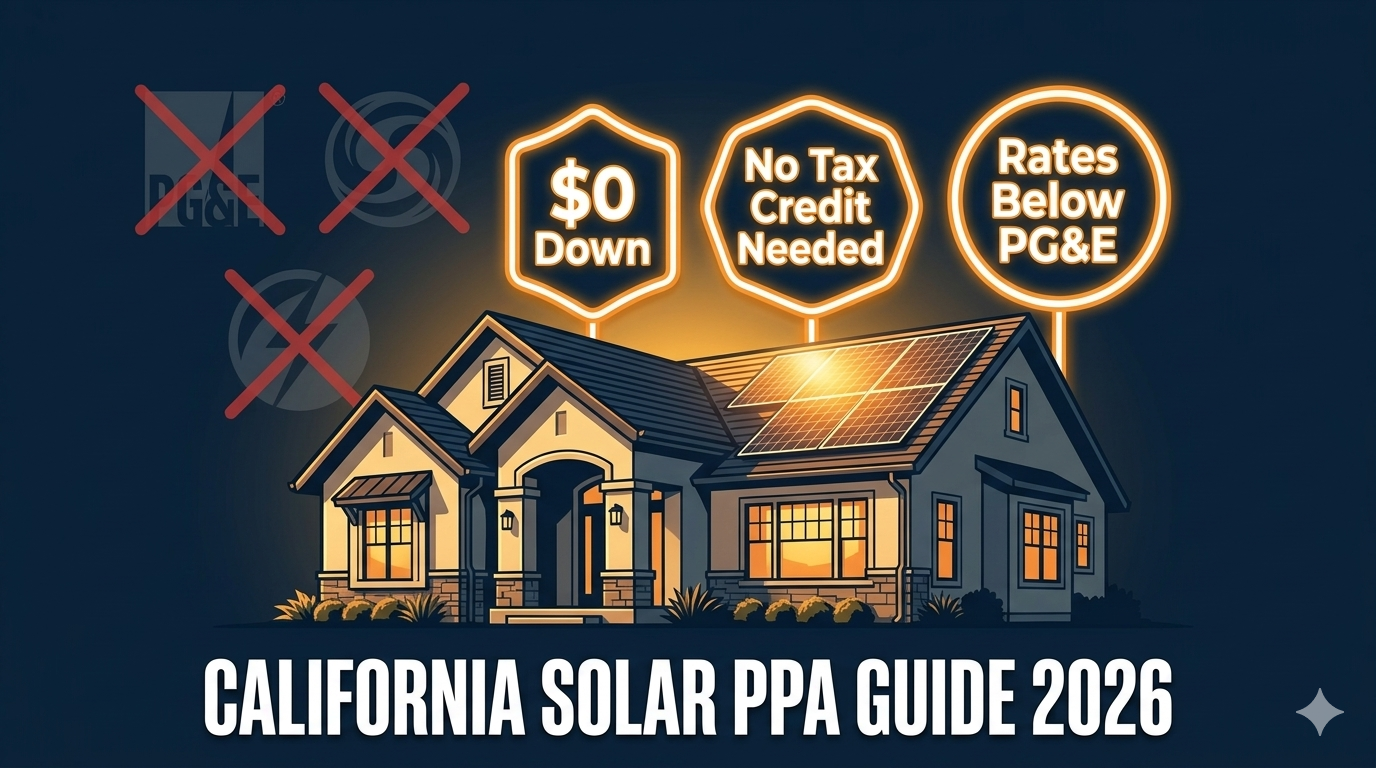
A Power Purchase Agreement means you never own the system — you pay for the electricity it produces at a fixed rate below your utility's price. $0 upfront, maintenance included, no credit score requirement for most programs. The trade-off: lower total savings over 20–25 years compared to ownership.
For homeowners who can't qualify for financing, don't want ownership responsibility, or want the simplest path to lower bills — a PPA from LightReach, GoodLeap, or EnFin delivers real savings from day one with zero complexity. Under NEM 3.0, battery storage alongside a PPA makes more sense than ever — LightReach is the only provider that includes battery in the same agreement.
✓ Best for: homeowners who want $0 upfront, zero maintenance responsibility, and immediate savings without ownership. Simpler than the prepaid lease but lower long-term ROI.
Head-to-Head: The Full Comparison
| Factor |
Cash Purchase |
Solar Loan |
⭐ Prepaid Lease |
PPA |
| Upfront cost |
Full price |
$0 down |
30% off at signing |
$0 |
| ITC / 30% discount |
Gone 2026 |
Gone 2026 |
Yes — via 3rd party |
Yes — via provider |
| System ownership |
Immediate |
Immediate |
After 5 years |
Never |
| Tax liability required |
N/A |
N/A |
None needed |
None needed |
| Maintenance |
Your cost |
Your cost |
Included (5 yrs) |
Always included |
| SMUD rebate stackable |
Yes |
Yes |
Yes — best stack |
Limited |
| Long-term savings |
Highest |
Strong |
Strong |
Moderate |
| 2026 net cost advantage |
Weakest (no ITC) |
Moderate |
Strongest |
Good ($0 down) |
California Homeowners · All Utilities
Show Me Which Option Fits My Situation
We'll run all four side by side with real numbers for your home, utility, and bill. Free, no credit pull, 60 seconds.
Show Me My Numbers →
🔒 No spam · No credit pull · Free · 1-hour local follow-up
Why the Prepaid Lease Is Winning in 2026
The reason is simple: it's the only structure that captures the 30% ITC without requiring the homeowner to have tax liability.
Under a prepaid lease, a third-party financing company owns the system and claims the 30% federal ITC at the corporate level. That credit — $18,000 on a $60,000 system — is passed directly to the homeowner as a discount applied at the point of sale. Your loan originates at $42,000, not $60,000. You never file for the credit. You never wait for a refund. The $18,000 is simply gone from your balance before you sign.
For the millions of California homeowners who wouldn't have been able to use the ITC anyway — retirees on fixed income, homeowners with limited tax liability, anyone whose income doesn't generate a $18,000 federal tax bill — the prepaid lease actually delivers the discount in a way the ITC never could.
SMUD territory homeowners get the strongest combined stack: 30% prepaid lease discount at signing + up to $5,400 per Powerwall SMUD battery rebate post-installation + $440/year per Powerwall in ongoing VPP payments. Three separate incentive layers running simultaneously.
See the full SMUD stack →
Which Option Is Right for You?
Choose This
⭐ Prepaid Lease
You want the best net cost in 2026. You can finance the discounted amount. You don't need or can't use a tax credit. SMUD customer who wants to stack battery incentives.
Choose This
Cash Purchase
You have significant cash reserves. You want maximum long-term ROI. You don't mind the higher upfront cost without the ITC. You plan to own the home 20+ years.
Choose This
Solar Loan
You want $0 down and immediate ownership. You have strong credit (650+). You've confirmed the interest rate and dealer fees make the numbers work for your bill amount.
Choose This
PPA
You want $0 upfront and zero maintenance responsibility. You don't care about ownership. You want the simplest path to lower bills — especially with LightReach's battery PPA option.
🔋
SMUD Territory
SMUD Battery Rebate Guide — Stack All Three Incentives
For Sacramento County SMUD homeowners — how the prepaid lease, battery rebate, and VPP payments stack together for the strongest combined value in California.
See the full SMUD incentive stack →
☀️
Related Guide
California Solar PPA Guide 2026 — LightReach, GoodLeap & EnFin Compared
The full breakdown of every $0-down PPA provider we work with — rates, terms, battery options, and which fits your utility territory.
Compare all PPA options →
Common Questions — California Solar Financing 2026
Is a solar lease or purchase better in California in 2026? +
In 2026, a prepaid lease is often the stronger option for most California homeowners compared to direct purchase — because the 30% federal ITC is no longer available for individual homeowners. The prepaid lease captures that 30% at the corporate level and passes it as a discount, meaning you pay 30% less than the direct purchase price without needing any personal tax liability. Direct purchase still makes sense for homeowners with large cash reserves who want maximum long-term ROI.
What is a prepaid solar lease and how does it work? +
A prepaid solar lease is a financing structure where a third-party company owns the system, claims the 30% federal ITC at the corporate level, and passes the full 30% as a price discount to you at the point of sale. You pay the discounted amount — either cash or via a solar loan — and own the system outright after 5 years. No tax filing required, no minimum tax liability, and the 30% comes off before your loan is ever originated.
Is the federal solar tax credit still available in California in 2026? +
The federal Residential Clean Energy Credit (25D) is no longer available for individual homeowners on systems placed in service after December 31, 2025. However, third-party system owners can still claim the 30% ITC through 2027. This is why prepaid lease financing delivers the equivalent of the 30% discount — the third-party owner claims the credit and passes the savings directly to you.
What is the difference between a solar PPA and a solar lease? +
A solar PPA (Power Purchase Agreement) means you pay for the electricity the system produces — a per-kWh rate below your utility's price. A solar lease means you pay a fixed monthly fee to use the system regardless of how much it produces. A prepaid lease is a variation where you pay the discounted system cost upfront (or finance it) and own the system after 5 years — it's not a PPA or a traditional lease. We present all options side by side so you can see the real difference for your specific home.
Which solar financing option is best for SMUD customers in Sacramento? +
For most Sacramento County SMUD customers, the
prepaid lease is the strongest option because it stacks directly with SMUD's incentive programs. The prepaid lease gives 30% off at signing. The SMUD My Energy Optimizer Partner+ rebate adds up to $5,400 per Powerwall post-installation. VPP payments add $440/year per Tesla Powerwall ongoing. Three separate incentive layers running simultaneously — none of which require a personal tax credit.
See the full SMUD incentive stack →
How does solar financing work under NEM 3.0 in California? +
Under NEM 3.0, export credits for PG&E, SCE, and SDG&E customers are significantly lower than under NEM 2.0. This means the financial case for solar now depends more on self-consumption and battery storage than on exporting to the grid. For financing, this strengthens the case for a prepaid lease + battery combination — because the battery maximizes self-consumption and the prepaid lease delivers the 30% discount that NEM 3.0 made more important. SMUD and Pioneer customers are not subject to NEM 3.0 and use a different rate structure.
California Homeowners · PG&E · SCE · SMUD · Pioneer
See All Four Options With Real Numbers for Your Home
Cash purchase, solar loan, prepaid lease, and PPA — compared side by side with real numbers for your utility, bill, and roof. 60 seconds to start. No credit pull. No obligation.
Get My Free Solar Comparison →
🔒 No spam · No credit pull · Free · CSLB #1065773 · Serving all of California
About the author: Ed Watts is the founder of Solar With Watts, a California solar sales and home energy company serving PG&E, SMUD, SCE, Pioneer Community Energy, and SDG&E territories. He has 10 years of solar sales experience with 400+ closed deals across Northern and Central California.
All figures are illustrative based on typical California system configurations. Final pricing, savings, and incentive eligibility confirmed at time of proposal. ITC/25D status based on current federal law as of March 2026 — consult a tax advisor for personal tax questions.